introduction
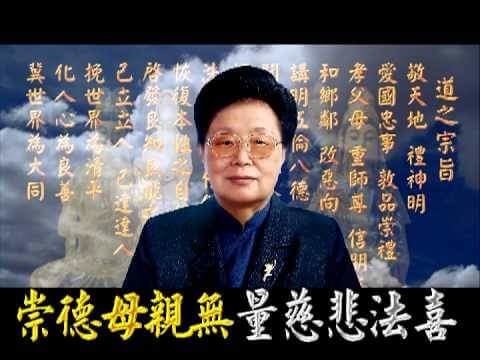
Yi Guan Dao, is one of the most significant spiritual movements in Taiwan. Its name can be literally translated as “The Dao that unifies all with oneness.”
The basis of Yi Guan Dao is rooted in Chinese traditions, with teachings emphasizing traditional values such as family, honor, respect and moderation. It is no exaggeration to call Yi Guan Dao the definitive and authentic Chinese form of spirituality.
The appeal of Yi Guan Dao is not limited to the Chinese. The movement is open to everyone regardless of ethnicity. Many people in the West have already experienced the warmth and acceptance of Tao practitioners. They have also discovered, withinYi Guan Dao, progressive teachings that resonate with the Western mind.
The Daoist part of theYi Guan Dao heritage is by far the oldest, going back at least to the time of Huang-ti, the legendary emperor who lived over 4,500 years ago.
About two thousand years after this ancient beginning, Lao Zi came along to summarize Daoist beliefs and concepts into the classic Dao De Jing. Another sage, Zhuang Zi, expanded upon these beliefs and concepts with stories, metaphors and a unique sense of humor.
Today, 2,500 years later, the teachings about the Dao have become the central tenets of Yi Guan Dao. These teachings describe the Dao as the ultimate principle beyond all principles and the ultimate power beyond all powers.
Yi Guan Dao asserts that the Dao is the essence and the spiritual truth behind all religions, philosophies, and schools of thought. It is also the source of everything, the driving mechanism of evolution, and the life force of the universe. The specialized name for this concept is Lao Mu, the personified manifestation of the nurturing, life-affirming, and creative power of the universe.
At about the same time as Lao Zi and Zhuang Zi, other sages were also developing their own perspectives on life and spirituality. Confucius became renowned as a great teacher and scholar as he codified social customs and ethics. To the south of China, the Buddha taught his followers the path toward enlightenment.
Confucian teachings and Buddhist thoughts both had profound impact on Chinese cultureYi Guan Dao recognizes their value, and integrates their teachings into the core of the belief system.
It is the nature of Yi Guan Dao to be open and receptive to different perspectives. The Dao goes beyond superficial, stylistic differences, and great wisdom should be treasured and cherished regardless of its source. By seeking commonalities among different traditions,Yi Guan Dao can move closer to the true essence, and perhaps avoid inflexible dogma.
Five hundred years after the time of Lao Zi, another remarkable teacher came into the world. His name was Jesus. He left a legacy that would come to serve as the foremost foundation of spirituality in the West.
With the same openness and receptivity that it has for all beliefs, Yi Guan Dao embraces and incorporates Christian teachings. Many Tao practitioners respect and study the Bible, again seeking the common thread of truth and wisdom that can bring the different beliefs closer to oneness.
In terms of formal lineage, Yi Guan Dao traces back to Bodhidharma, the Indian monk who visited China and originated Zen Buddhism.Yi Guan Dao reveres Bodhidharma as the first patriarch, or spiritual ancestor.
The lineage founded by Bodhidharma passed down through the generations to Hui Neng, the sixth patriarch of Zen Buddhism. Hui Neng’s deep insights and powerful intuition, as recorded in The Platform Sutra, became central elements of Dao cultivation.
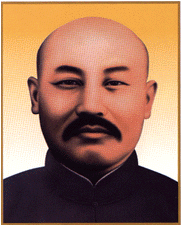
The lineage continued on after Hui Neng, generation after generation. The last patriarch of the lineage was the eighteenth. This final position was shared by two individuals that Tao practitioners call Shi Zueng (literally “teacher-reverend”) and Shi Mu (literally “teacher-mother”).
 |
 |
Shi Zhun |
Shi Mu |
In 1930, Shi Zueng and Shi Mu started their practice of Yi Guan Dao in Chi Nan City, Shang-Dong Province. Their work spread by word of mouth, and by 1946 Yi Guan Dao became prevalent among 36 provinces of China.
At the end of the Civil War in 1949, many Yi Guan Dao followers in China found their beliefs incompatible with Communist doctrines. They followed Shi Zueng and Shi Mu out of China, and established themselves in Taiwan.
Yi Guan Dao thrived and spread in Taiwan, despite initial attempts by the government to suppress it. Soon there were millions of followers, hundreds of temples, and tens of thousands of family shrines. This popularity was partly becauseYi Guan Dao offered new thinking that changed the religious landscape.
Previous to the influence of Yi Guan Dao, the vegetarian lifestyle was thought to be the sole domain of monks and nuns. Yi Guan Dao questioned this commonly accepted convention, and advocated vegetarianism for all Dao cultivators.
Because of this, vegetarianism became much more widespread. It used to be difficult to find vegetarian restaurants in Taiwan. Today anyone can find several within walking distance. This change would not have taken place without Yi Guan Dao
Yi Guan Dao insisted on having meetings where the learned can share their spiritual insights with others. This was quite different from the old paradigm, where monks and nuns studied scriptures but did not necessarily discuss them with the lay public in regularly scheduled classes.
Over time, people gradually became aware of theYi Guan Dao approach. They started to understand that the focus should not be on building temples or collecting donations. Spiritual teachings should take center stage. One by one, religious institutions adapted to this new awareness. Today, seminars and public forums on spiritual topics have become commonplace in Taiwan. The people benefit.
Not everyone is aware of the pivotal role thatYi Guan Dao has played in the above. This is because Dao cultivators refrain from trumpeting their own accomplishments. They prefer to do the work, achieve the result, and then quietly exit, hopefully without drawing any attention.
In this way, Yi Guan Dao adheres to the ancient teachings about the Tao. Like water, the Dao nourishes all, gives birth of all things, and then moves on to the next task without any expectations of recognition or rewards.
By seeking the commonality of all faiths and bringing everyone, regardless of religion, closer to the spiritual essence, Yi Guan Dao lives up to its name. It is truly the ideal of harmonious connections — the Dao that unifies all with oneness.